Spray foam insulation where you never need to access and bats for covering the sections that you might need to access.
I also wrapped my bats in painter’s drop cloth to prevent flooding damage to the insulation if it ever gets wet undet there again.
I have another suggestion. If you’re going to be moving the unit regularly, stop reading now and continue with one of the existing suggestions.
But…if you’re going to stay in one place for extended periods of time, it may be simpler to enclose (skirt), the entire underside of the trailer and insulate that.
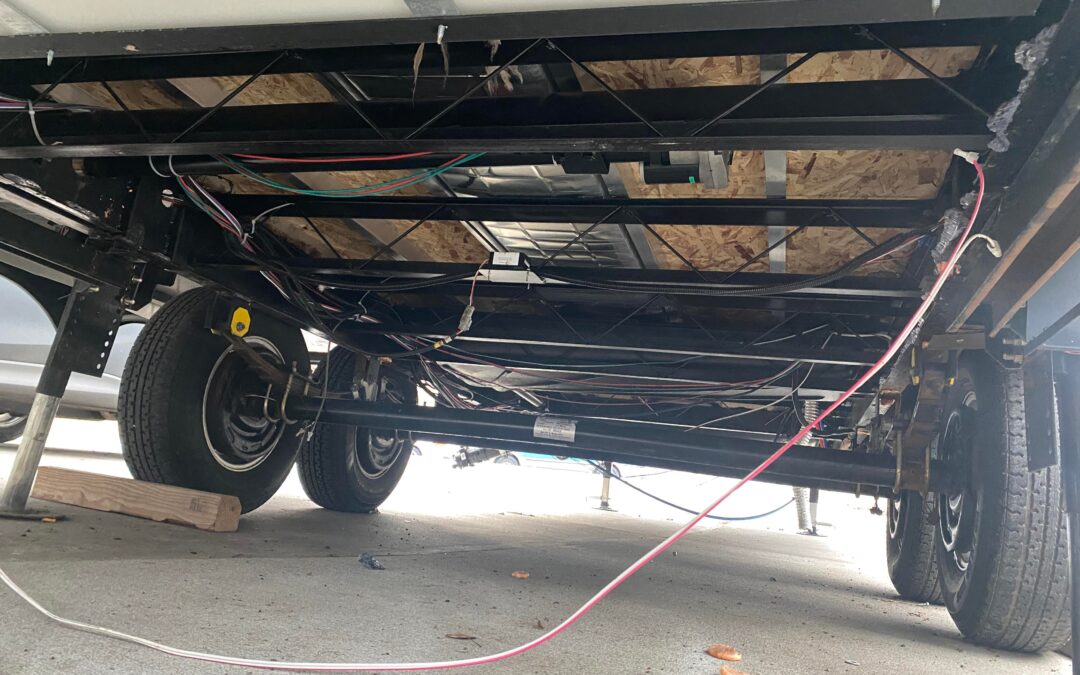
Because that model was never designed to be insulated from the bottom, dealing with all the wiring and plumbing is a challenge. And we all know that you’re eventually going to have to mess with both down there.
Take a look at metal building insulation rolls. They are extra wide and you can size them to each cavity. The ones you get at Home Depot are not large enough. I used these and they worked well when I replaced the entire underbelly insulation. You can also get it faced on one side to make it easier to work with and slightly moister resistance. Don’t go too thick, I tried to maximize the insulation thickness and it was a pain to install as well as service when I need to. I would recommend adding some thin metal supporting bands to help hold it up. By default the insulation is only held up by the underbelly plastic and it’s not really meant to hold up a lot of weight.
I’ve been on the road full time for the last 3 years in my 5th wheel and personally I’ve found there is never an area that you wont need future access to for repairs. So I would stay skip spray foam unless you want to seal some air gaps. Remember this is a vehicle and it flexes in your travels, large surfaces of spray foam will crack and not last over time.
We had a leak somewhere on the underbelly of our rig and started investigating only to find there used to be a mouse theme park living in the “crawlspace”. I’ve never seen so much mouse debris. We bought this rig less than a year ago and caught ~15 mice last summer. At the time we thought we were in a very active mouse area (we had mice get into the truck as well), but looking back I think we inherited the mouse city; I ended up finding peanuts and acorn shells in the crawlspace that we certainly haven’t been around.
So basically I had to rip all the insulation and waterproofing out (it was really, really bad) and am looking to re-insulate and seal in a better way. The rig is a “4-season” rig with heated holding tank space, but apparently all that means is there’s a 2ish” duct stubbed out in the middle that’s supposed to keep all 4 tanks from freezing; the two tanks closest to the duct essentially block the others, plus the only insulation layer below the tanks was a sheet of reflectix.
The original breakdown of the crawlspace (top down) was as follows: finished floor, osb subfloor, fiberglass batts, waterproof tarp material, large air gap, reflectix, corrugated platstic sheathing.
It’s time around I think I’m going to spray foam directly under the subfloor (waterproofing and insulation in one application) and then possibly build foam panel boxes with duct connections for each holding tank but leave the majority of the floor underbelly more open than before so I have access to wiring, slide out motors, plumbing, etc., if needed.
Curious what you all think? Are the heated holding tank boxes overkill? We have no interest in winter camping, but sometimes have to travel through cold areas to get to warmer spots. Granted nights still get chilly where we travel so I don’t want things to freeze up on us.
Most tanks these days have a 12 volt pad heater taped to them. Might be able to find those and install while it’s open. I always thought that spray foam would be a great way to insulate the underbelly. There is probably 2 reasons that does not happen
- too expensive for the factory to do
- additional weight
- difficult to impossible to access plumbing/wiring…
That said, I think I would go that way. Box out access panels and corridors with foam insulation, then spray foam the rest.
I would also look at the new style belly pan where it is segments that can be individually removed if needed.
Spray foam, or styrofoam rigid sheets (2 4 or 4 8). Spray foam is a Poluisocyanurate and is NOT 100% water proof and there is small degree of moisture absorption. Styrofoam is 100% water resistant, and would be my choice. Any other wool/mineral fibe application WILL take on water moisture.
Seal the frame edges with spay foam. Tack foam board in place with spay foam. Enclose the bottom with corplast, leaving the edges open to allow any water to escape but seal the seams with heavy duty tape.