
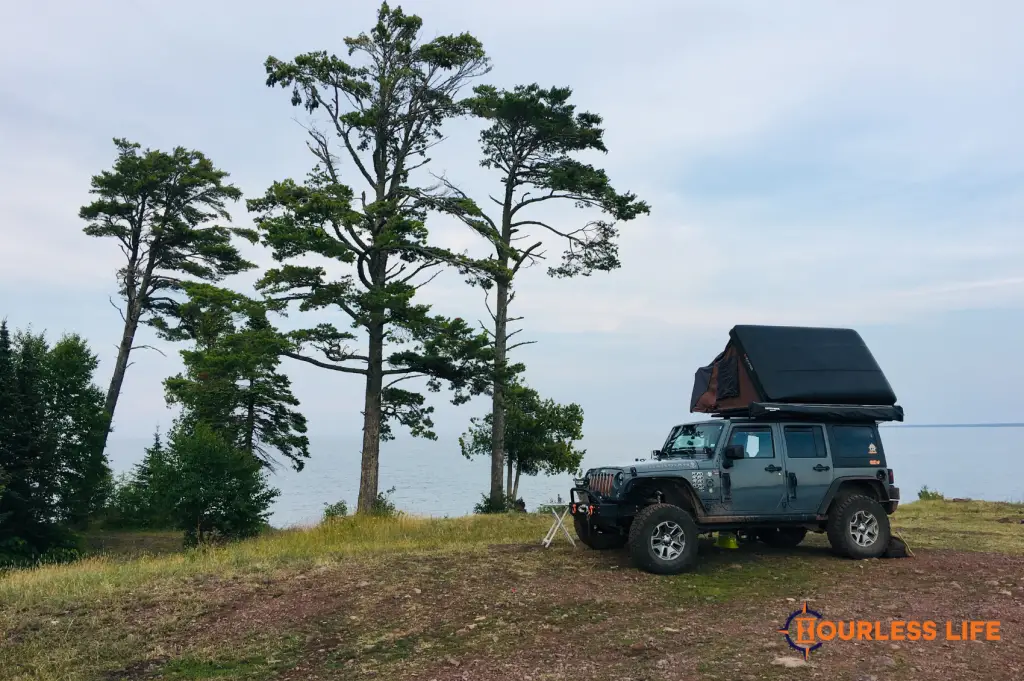
So you’ve got a Jeep Wrangler, or you are in the market for one, and you want to start an overland build. Overlanding is an incredible lifestyle, but there are some significant considerations, unique to Jeepers, that should be taken into account when building out a Jeep Wrangler for this purpose.
I live the overlanding life on the daily. I’ve done the research, made the mistakes, learned from them, refined my build, and through much trial and error we have our Jeep pretty dialed in.
Hopefully as you are going through this process I can save you some heartache, sweat equity from installs, time, and money.
You should know this is a Jeep-specific article. If you’re looking for general information and my thoughts on overlanding, consider checking out these other articles I’ve written:
- What is Overlanding?
- How to Choose an Overlanding Roof Top Tent Setup
- 30 Overlanding Resources Newbies Will Love
- Best Campground and Campsite Apps
There are many overland-related articles if you poke around our website. But for those considering building out a Jeep Wrangler specifically for overlanding, the rest of this article is specifically for you.
Author’s Note: This article is specific to the JK, JKU, JL, and JLU models. If you’re building a Jeep Wrangler JT (Gladiator), then this article may have some points of interest for you, but not all of it will apply.
Assessing the Obstacles

We all know the Jeep Wrangler is a remarkably capable off-road vehicle with an incredible history.
But the Jeep Wrangler wasn’t designed with overlanding in mind.
The three main drawbacks for the Jeep Wrangler platform are:
- Payload capacity
- Cargo space
- Fuel economy
A friend of mine on one of the forums I frequent summed it up best: “The Jeep Wrangler is one of the most capable vehicles ever built that can take almost nothing anywhere.”
He was right.
Though the Jeep Wrangler can take you pretty much anywhere you want to go, the payload capacity (how much weight you can carry), cargo capacity, and fuel economy of the Jeep Wrangler are the most significant limiting factors for its use as an overlanding vehicle–by comparison to other options out there.
The good news is the Jeep Wrangler is inarguably the most modifiable vehicle on the planet. This is a game changer. Why? Because if you’re intentional about your Jeep Wrangler overlanding build, then you can have an incredible platform that’s superior in capability to most other overlanding platforms, and still have everything you need to make your journey an enjoyable one. (All the Toyota guys are rolling their eyes right now.)
The best way to start, when considering a Jeep Wrangler overlanding build, is to first address the drawbacks I mentioned above. You need to figure out how to get past them effectively, economically, and efficiently as you build out your Jeep.
So let’s get started.
Obstacle #1: Payload Capacity

What is the payload capacity of the Jeep Wrangler?
In a word: subpar.
For those unfamiliar with the term, payload capacity refers to how much weight your vehicle can carry–including passengers and cargo.
Technically speaking, payload capacity is a calculation of the maximum payload your vehicle is designed to carry and still operate safely, as it was designed by the engineers who created it.
Figuring out your vehicle’s payload capacity is simple. Here is the formula:
GVWR (Gross Vehicle Weight Rating) – curb weight = payload capacity
To give you an example with our 2014 Jeep Wrangler Rubicon Unlimited, the equation looks like this: 5,700 lb GVWR – 4,521 lb curb weight = 1,179 lb payload capacity.
What this means is EVERYTHING we’re carrying, including passengers, extra water, gear, tools, recovery equipment…literally everything…cannot exceed 1179 pounds.
Let’s put this in perspective. A 2014 Toyota 4Runner has a payload capacity ranging from 1,495 to 1,700 pounds! At its base capacity, a 4Runner would give us 316 more pounds to play with. On the high end of that spectrum, we would have a whopping 516 pounds more.
Depending on the year, model, and trim of your Jeep Wrangler, your payload capacity could be anywhere from an abysmal 800 pounds to an almost respectable 1,310 pounds. You’ll have to check on your own individual model, as I can’t cover them all here. You can look up your Jeep’s factory build sheet here using your VIN to get more information on your specific vehicle.
Personally, I love the Jeep as a platform and I’d rather have the capability and modifiability of my Jeep than any other vehicle option out there. But understand if you are not Jeep loyal and want to get into the overlanding lifestyle, then you should consider other platforms with a higher payload capacity as your base.
Ultimately, the Jeep platform versus any other platform is going to be a trade-off, depending on what you want to be able to do.
The question that begs to be asked is: Can I increase the payload capacity of my vehicle?
The short answer is no.
There are some who will argue this response. But the truth is you can’t really increase payload capacity in a vehicle, without potential problems and significantly dangerous issues. You should plan your Jeep Wrangler overlanding build around the payload capacity your specific model is rated for.
The good news is that it is possible to have a really nice Jeep overlanding build with all the gear you need to have, and to do it well, as long as you plan accordingly.
You have options. One of those options is to tow a trailer for all of your overlanding needs. Personally I’m not a fan of trailers, but I’ll save why for another article.
Jeep Overlanding Build Tip #1: If you’re purchasing a Jeep specifically for overlanding, then get the Jeep with the highest payload capacity you can get, and make sure it has a towing package. These two things are more important than the color of the paint. Even if you aren’t planning on towing a trailer now, you may change your mind in the future. So again, consider the payload and towing package when making your purchase.
Obstacle #2: Cargo Space
I joked about the cargo space of a Jeep Wrangler in my tongue-in-cheek article, Buying a Jeep Wrangler: Should I Do It?
But the reality is cargo space in a Jeep is significantly lacking.
This is where we really get into the protips for building out a Jeep Wrangler for overlanding.
We’ve established that payload capacity and cargo are two main drawbacks to overlanding in a Jeep. So how do we make it work?
The simple answer to the problem of payload capacity and cargo space is backpacking gear.
Think about it.
Backpackers are an extremely hardcore subset of the outdoor community, much more so than us vehicle-based overland enthusiasts. These trailblazers literally carry everything on their backs up trails we wouldn’t even dream about traveling in our rigs.
Their ‘payload capacity’ is dependent upon their physical strength, and their cargo capacity is at an absolute minimum, yet they still need to pack in (and out) everything they need for their adventure.
This means backpacking gear is designed to be:
- Very lightweight
- Extremely compact
- Exceptionally durable
This revelation is a game changer for those building out a Jeep for overlanding purposes.
When you really think about it, backpackers would laugh at the payload capacity and cargo space “problems” we Jeepers have with our overlanding setup. Can you imagine if a backpacker could carry 1,179 pounds worth of gear?
When you really think about it, we have a ton of room by comparison to our backpacking counterparts and can carry much more in weight than they can.
So why not build out your overlanding arsenal using their gear? Makes sense, right?
Now I will say that because of the higher quality, lighter weight, and smaller footprint of backpacking gear, it can be expensive stuff. But if you’ve read any of my articles, you know that I have a “Buy once, cry once” philosophy when it comes to gear.
Don’t skimp when you’re making your choices on gear.
At the end of the day, you want your gear to last; you want it to take up as little space as possible in your rig; and you want the weight of your gear to be as light as possible because of payload restrictions.
Backpacking gear is the magic bullet, the solution to our first two major issues as Jeep overlanders.
Jeep Overlanding Build Tip #2: When it comes to overlanding gear you’re adding to your arsenal, stop buying camping gear and start buying backpacking gear! There is a massive difference. Use what you have when you’re getting started. But as you replace items or purchase new ones, opt for backpacking gear. It will save you a tremendous amount of both space and weight.
This leaves us with one more obstacle, and that is fuel economy.
Obstacle #3: Fuel Economy

Regardless of how much fuel your Jeep can hold, all Jeep gas mileage sucks.
It is a fact.
The good news is this drawback can be mitigated, as well.
Though I haven’t mentioned any specific gear anywhere in this article, I will make one exception here.
I’m a huge fan of the Titan Fuel Tanks Trail Trekker II external fuel tank. It holds 12 gallons of extra fuel on a grounded tank that attaches to the tailgate.
It came in really handy for us during our two overlanding journeys throughout Mexico where we covered over 4,000+ miles of ground.
With the Titan Fuel Tank Trail Trekker II, you can go from an empty tank of fuel to over a half tank of fuel in just six minutes.
Now you don’t have to use the Trail Trekker II. You can opt for Rotopax, which a lot of folks like using, or you can use an old-school Jerry can. But whatever you do, if you’re going off-grid for extended periods of time, then make sure you have some way to carry extra fuel.
Author’s Note: When we made the decision to drive around the world and committed to building out a new overland vehicle for that journey, we took the Titan Fuel Tank off our Jeep and sold it. It was the right call for us because we are going to keep GUARDIAN (our Jeep Wrangler Rubicon) in the Denver area for when we fly back to the states to visit family or participate in events. Since GUARDIAN will only be driven in the Lower 48 for the remainder of his service to us, we just don’t need the extra weight on him. Let’s face it, there aren’t many areas in the Lower 48 you can’t get to on a full tank of fuel.
Jeep Overlanding Build Tip #3: Make sure you have the ability to carry extra fuel. Remember not only you, but all of your gear and equipment, live in the Jeep. If you run out of fuel, then you’re going to have to hoof it to get some. So rather than have that issue, consider this a primary need for your Jeep overlanding build.
Other Considerations for Your Jeep Overlanding Build

With the three major drawbacks of a Jeep Wrangler overlanding build taken care of, everything else is pretty easy.
Other than what I listed above, I highly recommend you consider the following as you’re creating your build:
- Upgraded shocks
- Upgraded coil springs
- Good lift kit
- Upgraded differential covers
- Upgraded axles
- Off-road tires
- Aluminum bumpers, front and rear
- Aluminum or plastic fenders
- Aluminum skid plates
- Lockers
- Winch
- External lighting
There is a ton you can do with your Jeep Wrangler overlanding build to make it perfect for you and your family. Feel free to comment with any questions or for recommendations on specific products.
We’ve personally gone a little crazy. But this is what we really enjoy doing. So for us as full-time travelers, it’s not just our hobby, but our lifestyle.
If you’re interested, you can read about our personal Jeep Wrangler overlanding build here.
Closing Thoughts on Jeep Overlanding

You really only need water, shelter, food, warmth, and sleep in order to survive. (I cover basic overlanding needs in this article.)
But who wants to just survive, right?
The overlanding lifestyle is about the enjoyment of it all.
There are few things I enjoy more in this life than overlanding in my Jeep. I love this platform for the adventure we are on, and I’ve yet to find a place I want to set up camp that I can’t get to. (Though I’m still looking.)
If you’re a fellow Jeep overlander, or considering the lifestyle, I’d appreciate if you’d drop me a comment below. We love to connect with other overlanders (Jeepers and non-Jeepers) all over the world in our travels.
Get to know us. We’d love to get to know you.
Until next time, keep it dirty and wheels side down.
~ Eric, Brittany, and #LittleNomad
Source: 3 Obstacles You Must Overcome to Optimize Your Jeep Overlanding Build